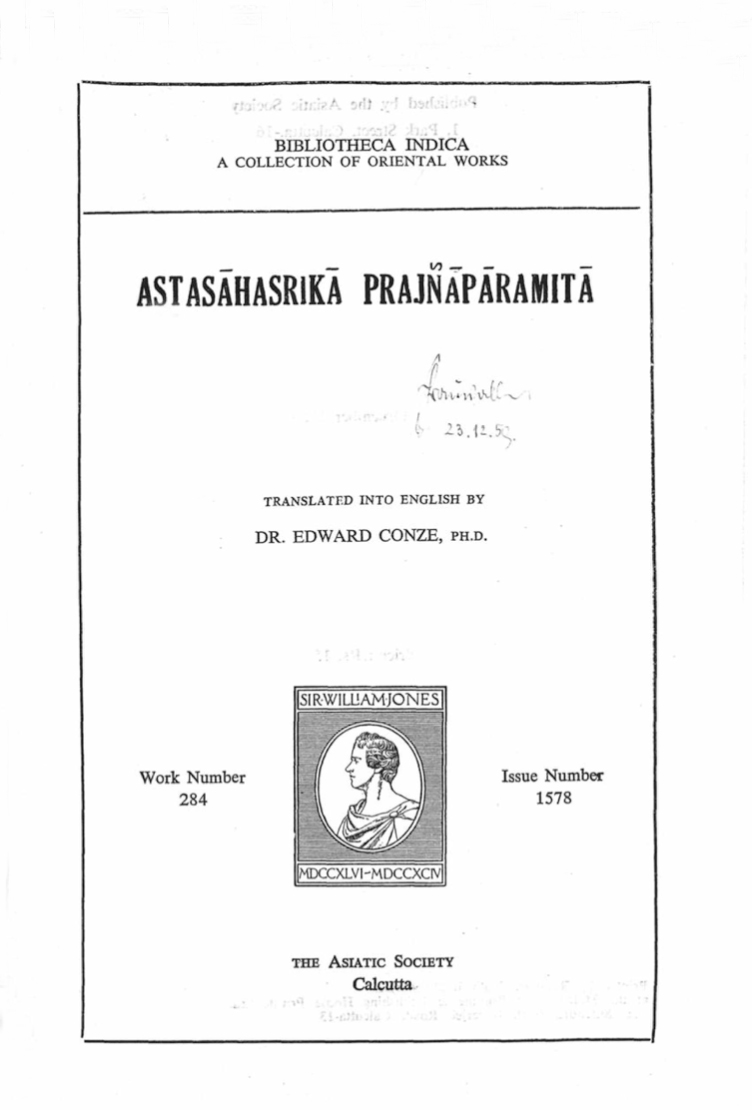
Aṣṭasāhasrikā Prajñāpāramitā (Conze 1958)
From Bodhicitta
< Books
Books/Aṣṭasāhasrikā Prajñāpāramitā (Conze 1958)| 🤓 Admin Zone 🛠️ hidden to non-admins | |
Aṣṭasāhasrikā Prajñāpāramitā
Book
Please note that many items in our library are simply pages that represent a detailed library catalog entry and citation of someone else's work, presentation, or performance. Read our General Disclaimer for more information.

Description
A literal, word by word translation of the Prajñāparamitā is tiresome to read, and practically unintelligible to any one who does not have the sanskrit original before him. If ever there was a case where the letter kills the spirit, it is here. The Sūtra itself was meant to be memorised, the translation is meant to be read. Lengthy repetitions, stereotyped phrases, and the piling up of synonyms were of great assistance to memory, but they irritate and distract the modern reader, and obscure from him the meaning of the text. This translation aims at bringing out the meaning of the Sūtra, often with the aid of Haribhadra's commentary, and it keeps as close to the text as is compatible with intelligibility. The reproduction of the literary conventions and of the stylistic peculiarities of Buddhist sanskrit diction was not one of my aims. It would be of little, or no, value to scholars, and it bewilders the general reader. To facilitate reference to the sanskrit original I have added in brackets the pages of Mitra's edition. (Conze, preface)
Citation
Conze, Edward, trans. Aṣṭasāhasrikā Prajñāpāramitā. Bibliotheca Indica 284. Calcutta: The Asiatic Society, 1958.
Table of contents
- Chapter 1 The practice of the knowledge of all modes1
- 1. Introduction
- 2. The extinction of self
- 3. The meaning of 'Bodhisattva'
- 4. The meaning of 'great being'
- 5. The meaning of 'great vehicle'
- 6. Attainment
- Chapter 2 Śakra15
- Chapter 3 Reverence for the receptacle of the perfections, which holds immeasurable good qualities22
- 1. Worldly advantages of perfect wisdom
- 2. The cult of perfect wisdom and the cult of the Buddhas
- 3. Perfect wisdom, a great spell
- 4. Perfect wisdom, and the other perfections 5. Further advantages from perfect wisdom
- Chapter 4 The proclamation of qualities35
- 1. Relative value of relics and of perfect wisdom
- 2. Simile of the wishing jewel
- 3. Supreme value of the perfection of wisdom
- Chapter 5 The revolution of merit39
- 1. Perfect wisdom a source of great merit
- 2. The counterfeit perfection of wisdom
- 3. Perfect wisdom greater than any other spiritual gift
- Chapter 6 Dedication and jubilation43
- 1. Supreme merit of dedication and jubilation
- 2. The range of jubilation
- 3. A metaphysical problem
- 4. How perverted views can be avoided
- 5. Considerations of merit
- Chapter7 Hell54
- 1. Hymn to perfect wisdom
- 2. Predominance of perfect wisdom over other perfections
- 3. Nothing procured by perfect wisdom
- 4. Why the perfection of wisdom is great
- 5. Causes of belief in the perfection of wisdom
- 6. Causes and consequences of disbelief
- Chapter 8 Purity62
- 1. Depth and purity of perfect wisdom
- 2. Attachments
- 3. Non-attachment
- 4. Like space or an echo
- 5. Conclusion
- Chapter 9 Praise69
- 1. Perfect wisdom perfectly pure
- 2. Effects of perfect wisdom
- 3. The second turning of the wheel of dharma
- 4. Modes and qualities of perfect wisdom
- Chapter 10 Proclamation of the qualities of bearing in mind73
- 1. Past deeds, and present attitude to perfect wisdom
- 2. Qualifications of a Bodhisattva who gets to perfect wisdom
- 3. Five similes to illustrate hearness to full enlightenment
- 4. Why Bodhisattvas are well-favoured by the Buddhas
- 5. Right attitude to perfect wisdom
- 6. Obstacles to perfect wisdom
- 7. The Bodhisattva sustained by the Buddhas
- 8. Prediction about spread of perfect wisdom
- 9. Description of Bodhisattvas who will study perfect wisdom
- Chapter 11 Māra's deeds83
- 1. Various deeds of Māra
- 2. The perfection of wisdom and the Sūtras of the Disciples
- 3. Various deeds of Māra
- 4. Sources of discord between teacher and pupil
- 5. Misdirection of aim
- 6. More discord between teacher and pupil
- 7. Māra dissuades from perfect wisdom
- 8. Anatagonism between Māra and Buddha
- Chapter 12 Showing the world93
- 1. Perfect wisdom the mother of the Buddhas
- 2. How the Tathāgata knows the world
- 3. How the Tathāgata knows the minds of beings
- 4. Deep marks, and how they are fastened
- 5. The world shown as empty
- Chapter 13 Unthinkable101
- 1. Five attributes of perfect wisdom
- 2. Spiritual rebirth resulting from this knowledge
- 3. Nothing to take hold of
- 4. Reaction of the Gods
- Chapter 14 Similes104
- 1. Future and past rebirths
- 2. Past deeds of a Bodhisattva who fails in perfect wisdom
- 3. Four similes
- Chapter 15 Gods108
- 1. The beginner's task
- 2. How a Bodhisattva helps beings
- 3. Description of perfect wisdom
- Chapter 16 Suchness113
- 1. Tathāgata-Suchness
- 2. The earth shakes, and many are saved
- 3. Perfect wisdom and skill in means
- 4. Enlightenment and emptiness
- 5. Requisites of going forth to enlightenment
- Chapter 17 Attributes, token and signs of irreversibility121
- 1. Various tokens of irreversibility
- 2. Māra's deeds
- 3. More tokens of irreversibility
- Chapter 18 Emptiness130
- 1. Deep stations
- 2. How to attend to perfect wisdom
- 3. Merit
- 4. Immeasurable, empty and talk
- 5. No growth or diminution
- Chapter 19 The Goddess of the Ganges134
- 1. Conditioned co-production
- 2. No development
- 3. No objective supports and no own-being
- 4. Five places which inspire fear
- 5. Prediction of the Goddess of the Ganges
- Chapter 20 Discussion of skill in means143
- 1. Emptiness and reality-limit
- 2. Three similes
- 3. Doors to deliverance, and vows about beings
- 4. Irreversibility
- 5. Dream experiences and the mark of irreversibility
- 6. Irreversibility and the magical power of veracity
- Chapter 21 Māra's deeds152
- 1. Pride and the magical power of veracity
- 2. Pride connected with the annunciation of the name
- 3. Faults in connection with detachment
- Chapter 22 The good friend158
- 1. The good friends
- 2. Emptiness, defilements and purification
- 3. Attentions to perfect wisdom, and the pearl of great price
- 4. Emptiness and growth in enlightenment
- Chapter 23 Śakra165
- 1. The superior position of Bodhisattvas
- 2. Rewards of perfect wisdom
- Chapter 24 Conceit168
- 1. Conditions which open a Bodhisattva to Māra’s influence
- 2. The Bodhisattva's right attitude to other Bodhisattvas
- Chapter 25 Training172
- 1. How a Bodhisattva is trained in all knowledge
- 2. Fewness of Bodhisattvas
- 3. Perfect wisdom comprehends all perfections
- 4. Merit from perfect wisdom
- 5. Bodhisattvas and Disciples
- Chapter 26 Like illusion177
- 1. Śakra praises the Bodhisattvas
- 2. Jubilation, turning over and merit
- 3. The nature of illusion
- Chapter 27 The core182
- 1. The Bodhisattva’s courage in difficulties
- 2. The Bodhisattva protected by the Gods, and against Māra
- 3. The Buddhas praise the Bodhisattva
- 4. Enlightenment and Suchness
- 5. Emptiness and dwelling in perfect wisdom
- Chapter 28 Avakīrṇakusuma188
- 1. Prediction of Avakīrṇakusuma
- 2. Praise of perfect wisdom
- 3. Transmission of the Sūtra to Ānanda
- 4. Akshobhya's Buddha-field
- 5. Extinction, non-extinction and perfect wisdom
- 6. Advantages derived from perfect wisdom
- Chapter 29 Approaches198
- Chapter 30 Sadaprarudita201
- 1. Sadaprarudita sets out to find perfect wisdom
- 2. Description of Gandhavatī, and of Dharmodgātā's life
- 3. List and significance of concentrations
- 4. Sadaprarudita and the merchant's daughter
- Chapter 31 Dharmodgātā216
- 1. The coming and going of the Tathāgatas
- 2. Sadaprarudita's self-sacrifice
- 3. Dharmodgātā’s demonstration of dharma
- Chapter 32 Entrusting224
- 1. End of the story of Sadaprarudita
- 2. The perfection of wisdom entrusted to Ānanda
Interconnections
1 Full translation of

The Perfection of Wisdom in Eight Thousand Lines, like other sūtras on the Perfection of Wisdom, deals with the topic of emptiness and the understanding of the ultimate truth or the way things are. Modern scholars date the sūtra roughly to the 2nd and 1st century BC and consider it to be the earliest sūtra on which other Perfection of Wisdom sūtras are based. Its adherents claim the sūtra to be a part of the words of the Buddha. It is believed to have been taken to the subterranean world and brought back to the human world by Nāgārjuna. It is sometimes known as the Condensed Mother (ཡུམ་བསྡུས་པ་), the term Mother referring to the Perfection of Wisdom which gives rise to all buddhas and bodhisattvas. It is said to be the condensed version of the long version in one hundred thousand lines and the middle version in twenty-five thousand lines. Having spread across Asia and beyond and having been translated into many languages, it is one of the most common books to be found in the Buddhist Himalayas.
The sūtra takes the form of a series of dialogues between the Buddha Śākyamuni, Subhūti, Śāriputra, and others, such as Indra, the king of gods, and a goddess of the Ganges. In the final chapters, the sūtra contains the inspirational narratives of Sadāprarudita and his quest for the teachings on the Perfection of Wisdom from the Bodhisattva Dharmodgata. The sūtra is also one of the earliest Mahāyāna sources proclaiming the luminous nature of the mind.