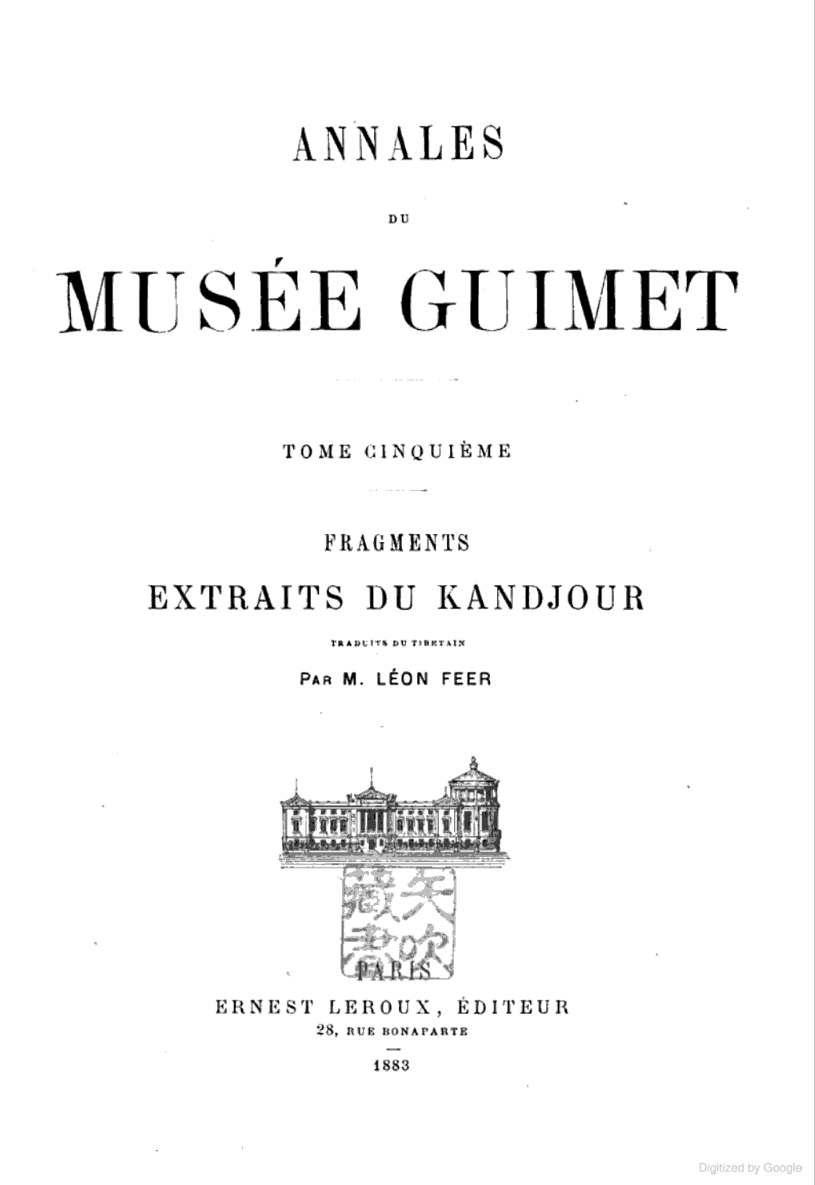
Maha-karuna-pundarika-sutra (Feer 1883)
| 🤓 Admin Zone 🛠️ hidden to non-admins | |
Description

Most of the sūtra's narrative, recounted by the Buddha on Vulture's Peak Mountain, takes place in the distant past and concerns the chakravartin king Araṇemin, his thousand sons, his chief court priest Samudrareṇu, and Samudrareṇu's followers and eighty-one sons, one of whom has sought enlightenment and become the Buddha Ratnagarbha. Samudrareṇu encourages people throughout the kingdom to aspire to attain enlightenment too, and eventually brings about the conditions for the king and many members of his court to make their own aspirations in the presence of the Buddha Ratnagarbha. On these occasions the Buddha Ratnagarbha prophesies the buddhahood of the individuals concerned. He prophesies that King Araṇemin will become the Buddha Amitabha; that 999 of Samudrareṇu's disciples, together with five of his attendants, will become the 1,004 buddhas of our Fortunate Eon; and that Samudrareṇu himself will become the Buddha Shakyamuni. Origin stories for the Buddha Akshobhya, for the Buddha Amitabha's accompanying bodhisattvas Avalokiteshvara and Mahasthamaprapta, and for the bodhisattvas Manjushri and Samantabhadra are also told.
The text explains how Shakyamuni is a buddha whose compassionate activity surpasses that of other buddhas because of the exceptionally powerful aspirations he made as Samudrareṇu in the presence of the Buddha Ratnagarbha. It also recounts miracles he accomplishes beyond anything else described in Mahāyāna Buddhist literature—such as bringing trillions of bodhisattvas into his body—and narratives of other previous lifetimes in which his generosity and self-sacrifice are unparalleled.
It therefore counters the seemingly justifiable notion that buddhas such as Amitabha and Akshobhya, who dwell for many eons in their pure buddhafields, have qualities greater than those of Shakyamuni, whose life was much shorter and whose buddhafield—this Saha world—appears so rough and impure. That Shakyamuni deliberately vowed to attain enlightenment and teach the hard-to-train beings in such a difficult environment is the very measure of his extraordinary compassion and exceptional activity. (Source Accessed April 3, 2025)
Lorsque j’ai préparé, pour le tome II des Années du. musée Guimet paru en 1881, la traduction de l’Analyse du Kandjour et du Tandjour publiée en anglais par Csoma de Körös en 183G, j’y avais joint, à titre de spécimen, un recueil de fragments traduits du Kandjour, dont quelques-uns étaient inédits, mais qui, pour la plupart, avaient déjà paru dans divers recueils, notamment dans le Journal asiatique. Ce
travail n’ayant pd être mis, comme je l’avais espéré, à la suite de l’Analyse de Csoma et dans le même volume, il fut décidé que lesdites traductions seraient imprimées en un volunfl spécial qui devait être le cinquième des Annuls. Mais alors, le même recueil, qui avait été jugé trop considérable pour entrer dans le volume II, se trouvait bien exigu pour former le volume V. Je profitai donc de la circonstance pour le grossir de quelques traductions nouvelles, déjà commencées ou projetées, qui n’avaient pas été prêtes à temps pour entrer dans la première formation. Ainsi s’est constitué par adjonctions successives le volume que nous offrons aujourd’hui au lecteur. (Feer, preface, v)