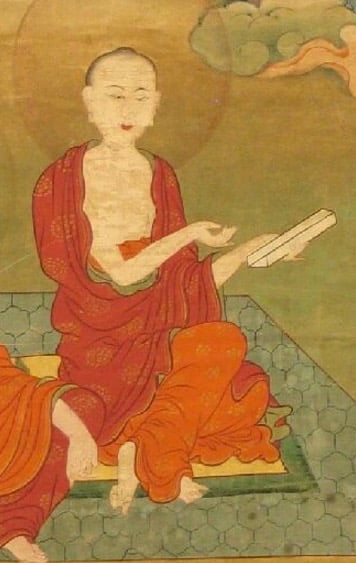
Jewel Brocade Receives the Prediction
| 🤓 Admin Zone 🛠️ hidden to non-admins | |
Description
The Sutra of Sāgara, the Nāga King is also known as The Sutra of the Nāga King Sāgara Who Asked about the Incantations (Dhāraṇī) and The Sutra of the Accumulation of the Pure Dharma, the Dharma Jewel. This sutra was translated into Chinese by Dharmarakṣa in A.D. 285 and is also extant in Tibetan.
The first half of the sutra takes place on Vulture Peak (Gṛdhrakūṭa), the latter half in the Nāga king's oceanic palace. The principal teachings of the text are the Bodhisattva practice and the inexhaustible Dharma of Mahāyāna. This sutra is divided into twenty chapters, the main exposition is in the fourth chapter, "The Inexhaustible Storehouse"[11] [of Bodhisattva practice] through the sixth chapter, "The Body of Incantations." The principal theme is that the Mahāyāna teaching is embodied in the
incantation of the inexhaustible storehouse of merits which are accumulated by the Bodhisattva practice.
The Sutra of Sāgara, the Nāga King appears to have been greatly influenced by the Prajñāpāramitā but also suggests influence from the Pure Land school because of its reference to being born in the Buddha's land after hearing his name,[12] probably referring to the Buddha Amitābha and Pure Land. During the Nara period in Japan, this sutra gained immense popularity as a sacred text for the rituals of rain ceremonies because of the rain-giving faculty attributed to the Nāgas. The text was also used in rain ceremonies in China where sometimes as many as eleven hundred Buddhist priests attended the ritual.
Chapter 14, "Jewel Brocade Receives the Prediction," is strikingly similar to the Nāga princess episode in the Lotus Sutra and utilizes the same argument as the Vimalakīrtinirdeśa episode concerning the goddess.[13]
In the following episode, Jewel Brocade focuses on the key issue of the illusion of sexuality by arguing the case that all phenomena are equal in nature, that is, Empty, and should not be discriminated as being different in nature. The teaching of Emptiness is the fundamental and dominant theme in all Mahāyāna Buddhist literature. In accordance with that theme, the denial of innate sexual characteristics is a necessary corollary. The Sutra of Sāgara, the Nāga King is not the first text to conclude that there is no sexual discrimination if one accepts the teaching of Emptiness. In the Ta-chih tu lun (Mahāprajñāpāramitāśāstra), the discriminative characteristics of men and women are analogous to the ignorant individual's perception of water in a mirage.[14]
- If the characteristics of men and women are [discriminated as] identical or different, their true nature is unattainable. Why? Because phenomena [Dharmas] are neither the ego nor belong to the ego; they are Empty. Because they are Empty, there is neither male nor female.[15]
The commentary cites an author who explains that:
- . . . although women have superficial knowledge, conditioned by their past karma, they are able to receive a prediction [of future Buddhahood]. Because they express such a desire in their hearts, the Buddha will listen to them.[16]
Like the serpent princess in the Lotus Sutra, Jewel Brocade also offers her most precious jewel to the Buddha as a sign of her commitment to learn about his teaching. She immediately awakens to the thought of enlightenment, which indicates that she is a beginner Bodhisattva of the first stage and asserts, with her companions, that she will become a Buddha. Mahākāśyapa, the spokesman for the conservative Buddhist attitude toward women, immediately reminds the princess of the female sex's limitations. Here we see a different response to the conservative Buddhist position with regard to women. Unlike the Nāga princess in the Lotus Sutra who defers to the monk by changing into a male, Jewel Brocade replies that the Buddha's teaching has no male or female qualities. The princess then engages in a discourse on Emptiness which denies discriminations of any kind.
The episode of Jewel Brocade not only illustrates in a humorous way the comment from the Ta-chih tu lun that the Buddha will listen to those who desire in their hearts to commit themselves to the Bodhisattva practice but also ignores the sexual change required of aspiring young female Bodhisattvas, which we have found in other Buddhist texts. The Dharma removes notions of sexuality for those practicing the Bodhisattva path. (Paul, introduction, 232–34)
Notes
11. Chinese: wu-chin Isang.
12. See also Chapter 1, "Practice," in The Sutra of Sāgara, the Nāga King, T. v. 15, n. 598.
13. The Jewel Brocade tale appears to have been influenced by the Vimalakīrti sutra, having been translated approximately sixty years after the first recension of the Vimalakīrti which is no longer extant.
14. T. v. 25, n. 1509, p. 102 b 2-4.
15. T. v. 25, n. 1509, p. 206 b 6-8.
16. T. v. 25, n. 1509, p. 591 c. 10–12.