Can We Know Whether Śāntideva was a Consequentialist? (Goodman 2023)
From Bodhicitta
< Articles
Articles/Can We Know Whether Śāntideva was a Consequentialist? (Goodman 2023)| 🤓 Admin Zone 🛠️ hidden to non-admins | |
Can We Know Whether Śāntideva was a Consequentialist?
Chapter in a Book
Please note that many items in our library are simply pages that represent a detailed library catalog entry and citation of someone else's work, presentation, or performance. Read our General Disclaimer for more information.
Description
Can we describe the ethical views of premodern Buddhist authors, without distorting them, using the terms and concepts employed in contemporary discussions of philosophical ethics? If we can, just how should we do so? Mark Siderits was one of the first authors to propose that we try to understand the normative views of the South Asian Buddhist tradition considered as a whole,[1] and of Śāntideva in particular,[2] as forms of consequentialism. Since his pioneering work, the discussion has advanced considerably, and scholars have raised a number of questions about, and objections against, consequentialist interpretations of Buddhist ethics. This paper defends a consequentialist interpretation of Śāntideva in particular, offering replies to the most important of these questions and objections. If my arguments are successful, they reveal that Siderits’ pioneering articles about Buddhist ethics were quite close to the mark, at least so far as Śāntideva is concerned. (Goodman, preliminary remarks, 437)
Citation
Goodman, Charles. "Can We Know Whether Śāntideva was a Consequentialist?" In Reasons and Empty Persons: Mind, Metaphysics and Morality. Essays in Honor of Mark Siderits. Edited by Christian Coseru, 437–57. Cham, Switzerland: Springer Publishing, 2023.
Interconnections
1 Chapter or part of
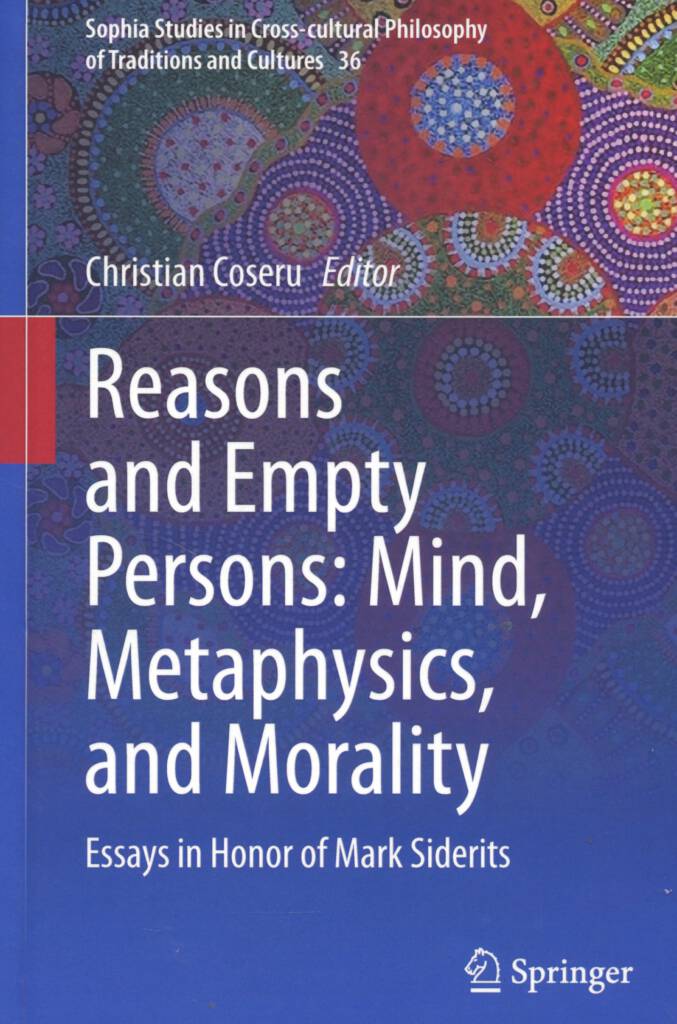
-front.jpg)
Best known for his groundbreaking and influential work in Buddhist philosophy, Mark Siderits is the pioneer of “fusion” or “confluence philosophy", a boldly systematic approach to doing philosophy premised on the idea that rational reconstruction of positions in one tradition in light of another can sometimes help address perennial problems and often lead to new and valuable insights.
Exemplifying the many virtues of the confluence approach, this collection of essays covers all core areas of Buddhist philosophy, as well as topics and disputes in contemporary Western philosophy relevant to its study. They consider in particular the ways in which questions concerning personal identity figure in debates about agency, cognition, causality, ontological foundations, foundational truths, and moral cultivation.
Most of these essays engage Siderits’ work directly, building on his pathbreaking ideas and interpretations. Many deal with issues that have become a common staple in philosophical engagements with traditions outside the West. Their variety and breadth bear testimony to the legacy of Siderits’ impact in shaping the contemporary conversation in Buddhist philosophy and its reverberations in mainstream philosophy, giving readers a clear sense of the remarkable scope of his work. (Source: Springer)