"Revelation" in Mādhyamika Buddhism: Chapter Eleven of the Samādhirāja Sūtra
From Bodhicitta
(Redirected from "Revelation" in Mādhyamika Buddhism: Chapter Eleven of the Samādhirāja Sūtra)
Dissertations/"Revelation" in Mādhyamika Buddhism: Chapter Eleven of the Samādhirāja Sūtra
Dissertations/"Revelation" in Mādhyamika Buddhism: Chapter Eleven of the Samādhirāja Sūtra
| 🤓 Admin Zone 🛠️ hidden to non-admins | |
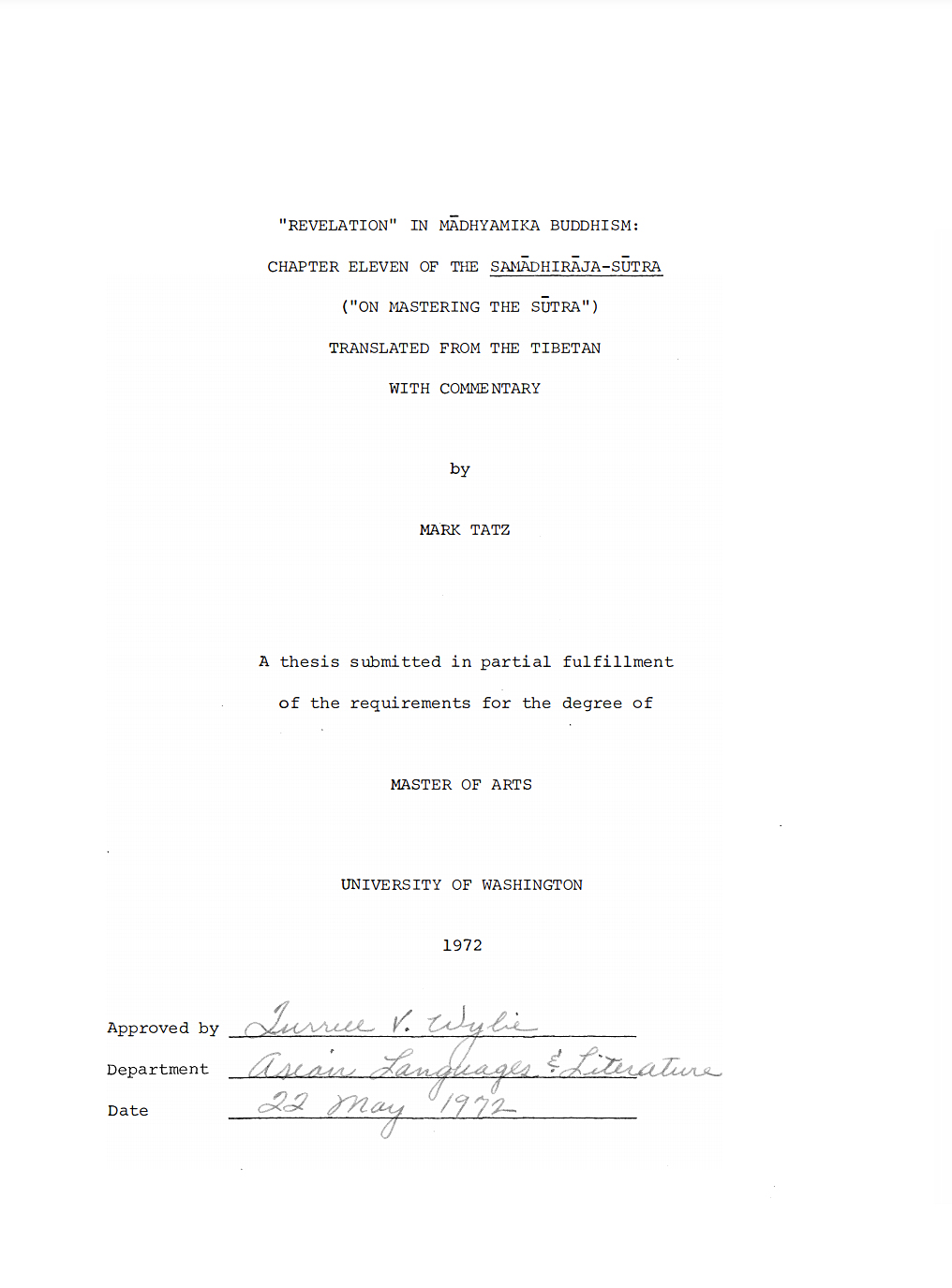
"Revelation" in Mādhyamika Buddhism: Chapter Eleven of the Samādhirāja Sūtra ("On Mastering the Sūtra"); Translated from the Tibetan with Commentary
Please note that many items in our library are simply pages that represent a detailed library catalog entry and citation of someone else's work, presentation, or performance. Read our General Disclaimer for more information.

Description
The translation of one chapter of the Samadhiraja-sutra sets out on the path begun jointly by Regamey and Schayer in the 30's. We have the benefit not only of their pioneering labors, but of road-building tools unavailable to them. Since their time some excellent editorial work has been done by Nalinaksa Dutt on the Sanskrit text, and its philosophic groundwork has been thoroughly explored by western and Indian scholars. Furthermore its place in the Tibetan context has been discovered. Any failings, therefore, will not reflect on their magnificent example.
The chapter presented here is the eleventh, "On Mastering the Sūtra" (mdo sde 'dzin pa'i le'u). It is of interest for its discussion of the Bodhisattva's function in the world.
The full title of the sutra, as it appears in the Bka'-' gyur, is the Arya-sarvadharma-svabhāva-samatā-vipañcita-samādhirāja-mahāyāna-sūtra, "the noble sūtra of the greater vehicle, known as the King of Samādhis, which explains in detail the similarity of all dharmas in their own-being." It is also known as the Candrapradīpa after its principal interlocutor, the Bodhisattva Candraprabha. It is an expansive (vaipulya) sūtra, surviving in its entirety in Sanskrit and Tibetan, which elaborates in great detail the doctrines and practices of the early Mādhyamika. It is a source-work for the philosophy of the leaders of the Mahāyāna in India, from Candrakīrti to Atīśa. Its translation and that of the major commentary were done during the two "great spreads" of the Doctrine in Tibet, and in that country tooit has been a fundamental text. (Tatz, introduction, 1–2)
The chapter presented here is the eleventh, "On Mastering the Sūtra" (mdo sde 'dzin pa'i le'u). It is of interest for its discussion of the Bodhisattva's function in the world.
The full title of the sutra, as it appears in the Bka'-' gyur, is the Arya-sarvadharma-svabhāva-samatā-vipañcita-samādhirāja-mahāyāna-sūtra, "the noble sūtra of the greater vehicle, known as the King of Samādhis, which explains in detail the similarity of all dharmas in their own-being." It is also known as the Candrapradīpa after its principal interlocutor, the Bodhisattva Candraprabha. It is an expansive (vaipulya) sūtra, surviving in its entirety in Sanskrit and Tibetan, which elaborates in great detail the doctrines and practices of the early Mādhyamika. It is a source-work for the philosophy of the leaders of the Mahāyāna in India, from Candrakīrti to Atīśa. Its translation and that of the major commentary were done during the two "great spreads" of the Doctrine in Tibet, and in that country tooit has been a fundamental text. (Tatz, introduction, 1–2)
Citation
Tatz, Mark. "'Revelation' in Mādhyamika Buddhism: Chapter Eleven of the Samādhirāja Sūtra ('On Mastering the Sūtra'); Translated from the Tibetan with Commentary." MA thesis, University of Washington, 1972. https://u1lib.org/book/2064265/12d311.
Table of contents
- I. INTRODUCTION1
- A. Text and Sources2
- B. What is the Samādhirāja-sūtra?4
- C. What is a Sūtra?5
- D. The SR in Indian Buddhist Tradition8
- E. Dating10
- F. The Tibetan Translation13
- G. Translation of the Kīrtimālā Commentary14
- H. Importance to the Tibetan Schools16
- I. Doctrine and Terms: Some Notes on the Madhyamika19
- J. Tibetan Translation-style28
- K. Chapter XI in Context31
- II. NOTES TO THE INTRODUCTION34
- III. CHAPTER XI OF THE SR,
- TIBETAN TEXT AND ENGLISH TRANSLATION47
- IV. COMMENTARY TO THE TRANSLATION ,
- INCORPORATING THE KĪRTlMĀLĀ86
- A. Prolegomena86
- B. Hosanna91
- C. Preface to Candraprabha's Questioning99
- D. Candraprabha's Enquiry of the Buddha100
- E. The Buddha's Response (in prose)107
- F. Verse Preaching of the Tathāgata109
- V. NOTES TO THE COMMENTARY144
- VI. APPENDIX 186
- VII. INDEX, TIBETAN-SANSKRIT-ENGLISH188
- VIII. BIBLIOGRAPHY AND ABBREVIATIONS196
Interconnections
1 Partial translation of

This sūtra, much quoted in later Buddhist writings for its profound statements especially on the nature of emptiness, relates a long teaching given by the Buddha mainly in response to questions put by a young layman, Candraprabha. The samādhi that is the subject of the sūtra, in spite of its name, primarily consists of various aspects of conduct, motivation, and the understanding of emptiness; it is also a way of referring to the sūtra itself. The teaching given in the sūtra is the instruction to be dedicated to the possession and promulgation of the samādhi, and to the necessary conduct of a bodhisattva, which is exemplified by a number of accounts from the Buddha's previous lives. Most of the teaching takes place on Vulture Peak Mountain, with an interlude recounting the Buddha's invitation and visit to Candraprabha's home in Rājagṛha, where he continues to teach Candraprabha before returning to Vulture Peak Mountain. In one subsequent chapter the Buddha responds to a request by Ānanda, and the text concludes with a commitment by Ānanda to maintain this teaching in the future. (Source: 84000)
1 Scholarship on
This sūtra, much quoted in later Buddhist writings for its profound statements especially on the nature of emptiness, relates a long teaching given by the Buddha mainly in response to questions put by a young layman, Candraprabha. The samādhi that is the subject of the sūtra, in spite of its name, primarily consists of various aspects of conduct, motivation, and the understanding of emptiness; it is also a way of referring to the sūtra itself. The teaching given in the sūtra is the instruction to be dedicated to the possession and promulgation of the samādhi, and to the necessary conduct of a bodhisattva, which is exemplified by a number of accounts from the Buddha's previous lives. Most of the teaching takes place on Vulture Peak Mountain, with an interlude recounting the Buddha's invitation and visit to Candraprabha's home in Rājagṛha, where he continues to teach Candraprabha before returning to Vulture Peak Mountain. In one subsequent chapter the Buddha responds to a request by Ānanda, and the text concludes with a commitment by Ānanda to maintain this teaching in the future. (Source: 84000)